In short: A Nigerian invoice needs both parties' details, your TIN and CAC number, a sequential number and date, itemised lines in naira, a VAT decision you can defend, bank details with a reference, and terms. Corporate clients will deduct withholding tax from what they pay you, so the TIN is not decoration. From July 2027 most businesses will also need each invoice validated by the NRS.
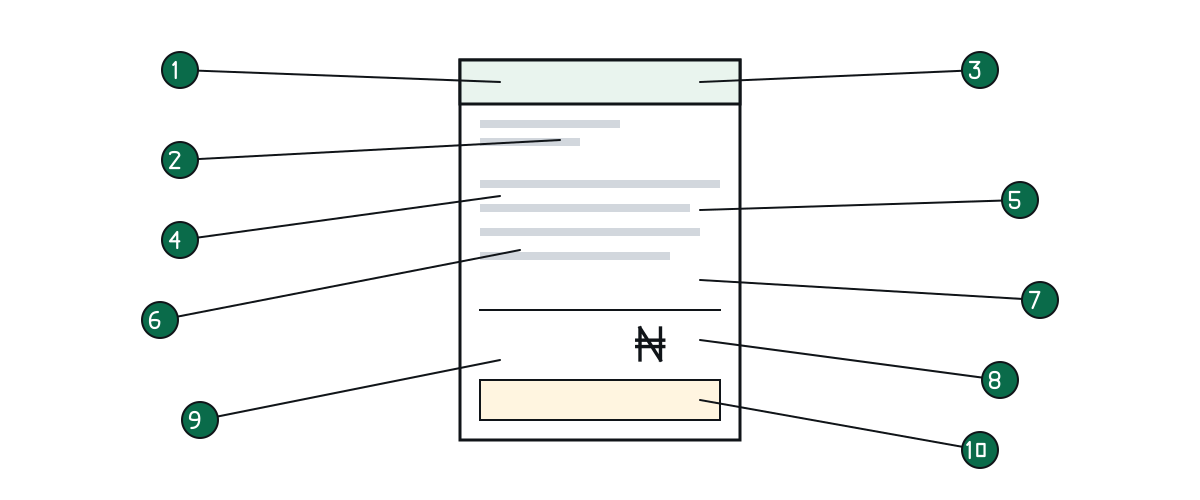
The ten things on the page
- Your business name and address. As registered with the CAC if you are registered.
- Your TIN. The Tax Identification Number is how a client remits withholding tax under your name. Without it, the deduction they make cannot be credited to you.
- Your CAC number. RC for a limited company, BN for a business name. It tells the client they are dealing with a registered business.
- The client's name and address, and their TIN if they are a company.
- A unique, sequential invoice number. INV-2026-001, then 002. Gaps are questions you will have to answer later.
- Issue date and due date. Net 7 for small trades, net 14 to 30 for corporate clients.
- Line items with description, quantity, unit price and amount, in naira.
- Subtotal, VAT if applicable, and total. If you do not charge VAT, say so on the invoice.
- Bank details with the invoice number as the transfer reference, so the payment can be matched.
- Terms and notes: deposit received, balance due, delivery date, warranty, late-payment rule.
The invoice generator has a field for each of these and prints them in that order.
Should you charge VAT?
Only if your business is above the small-company threshold. The Nigeria Tax Act 2025 sets it at ₦50m turnover; the Administration Act uses ₦100m and the two have not been reconciled. Below the threshold you do not register for VAT and should not add 7.5% to invoices. Above it you must register, charge 7.5% on taxable supplies, and file by the 21st of the following month. Some supplies are zero-rated regardless: basic food, medicines, books, tuition, residential rent. Use the VAT calculator to add or strip the 7.5%.
Withholding tax will reduce what you receive
When a company pays you, it must deduct withholding tax and remit it to the NRS on your behalf: 5% on professional and consultancy fees and commission, 2% on supply of goods and general services, 10% on rent. You receive the net amount and a credit against your own tax. Two consequences: quote knowing that a corporate payment arrives net, and make sure your TIN is on the invoice so the credit reaches you. The withholding tax calculator shows the deduction for any payment.
Deposits, proformas and balance
For any job that needs money up front, send a proforma invoice first. It is a quotation with a validity date, not a demand for payment, and it does not enter your sales ledger. When the deposit lands, do the work, then issue the final invoice showing the total, the deposit received and the balance due. The proforma generator and the invoice generator share the same fields so the second document takes a minute.
Sending it
WhatsApp is how most Nigerian invoices travel. Send the PDF, not a screenshot: a PDF keeps the numbers legible and cannot be edited in a chat. Follow up on the due date, not after it.
What changes with e-invoicing
Nigeria is moving every business onto invoices validated by the NRS Merchant-Buyer Solution. Large taxpayers are live, medium taxpayers went live in July 2026, and businesses under ₦1bn go live on 1 July 2027 with enforcement from January 2028. Each invoice will be submitted, stamped with an Invoice Reference Number and a QR code, and only validated invoices will count for VAT and WHT. Everything above prepares you for that: the fields are the same, the sequencing matters more, and invoices kept in a system rather than a chat are the ones that can be submitted. The e-invoicing guide has the timeline and penalties.